Broccoli Haircut Maintenance: The Complete Daily, Weekly, and Monthly Guide
Keep your broccoli haircut looking fresh with this comprehensive maintenance guide. From daily styling routines to haircut schedules and product recommendations.
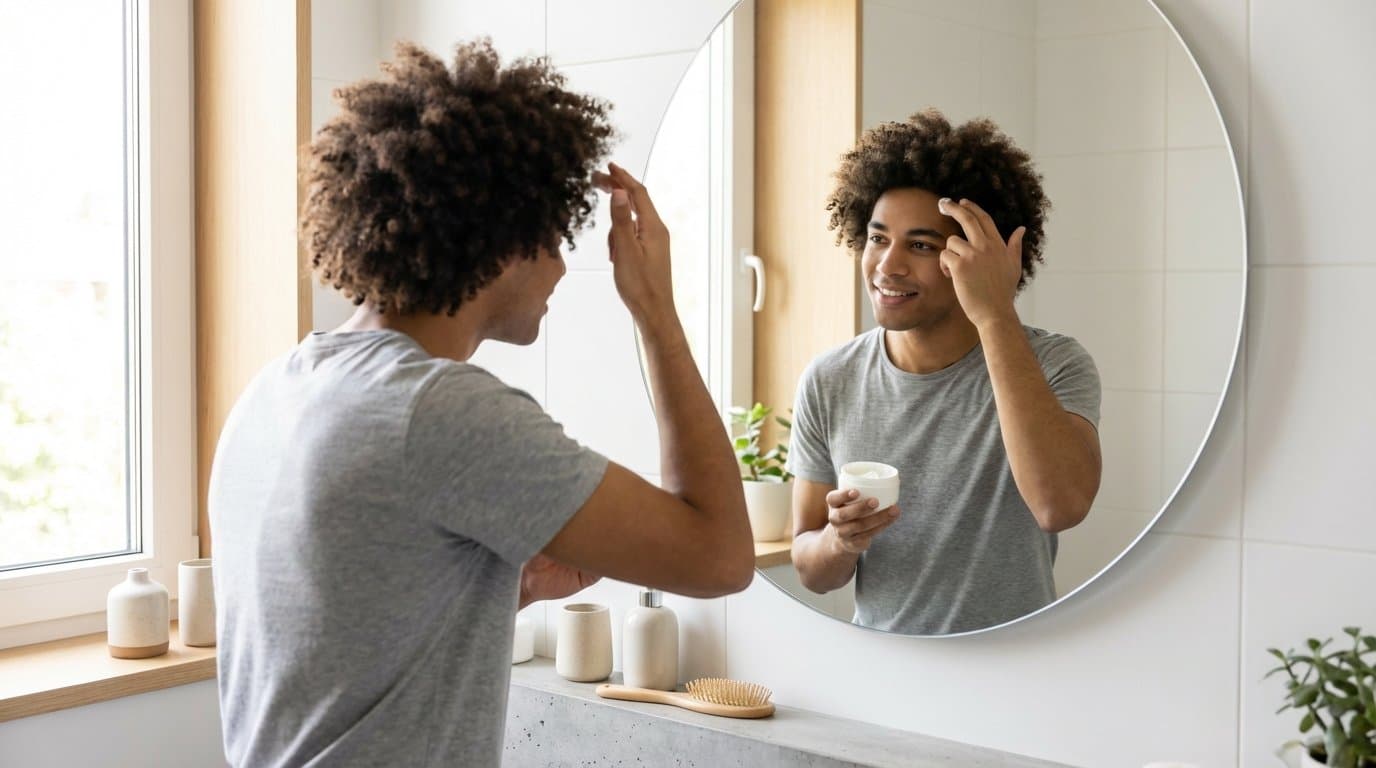
You got the broccoli cut. It looks great. Now what?
Unlike some low-maintenance styles where you can roll out of bed and go, the broccoli haircut requires attention. Those voluminous curls and that clean fade don't maintain themselves.
This guide covers everything you need to know about keeping your broccoli cut looking fresh: daily routines, weekly treatments, monthly barbershop visits, and all the products that make it work.
Daily Maintenance: The Morning Routine
Your daily routine sets the foundation. Here's how to style your broccoli cut each morning. (For the deep dive on the styling technique itself — products, scrunching, diffusing — our step-by-step styling guide covers it all; this section is the quick version.)
Step 1: Start with Damp Hair
You have options here:
- Shower and towel dry: The traditional approach. Gives you maximum styling control.
- Wet it at the sink: Faster if you don't need a full shower.
- Use a spray bottle: Even faster. Just dampen enough to reshape.
- Refresh from yesterday: If your curls held overnight, you might just need minor touch-ups.
The key is damp, not soaking wet. Squeeze out excess water with a microfiber towel or t-shirt. Don't rub—scrunching preserves curl formation.
Step 2: Apply Leave-In Conditioner
Curly hair (natural or permed) needs moisture. A leave-in conditioner prevents frizz and keeps curls healthy.
How to apply:
- Put a small amount in your palms
- Rub hands together to distribute
- Work through hair, focusing on the curly top
- Make sure ends are covered
Amount: Start with a dime-sized dollop. You can always add more.
Step 3: Add Your Styling Product
This is where you get the hold and definition that makes the broccoli cut work.
Product options:
Curl cream: Lightweight, natural finish. Good for everyday. Mousse: Adds volume without weight. Great for limp curls. Gel: More hold and definition. Can look wet or crunchy if overdone. Curl paste/pomade: Medium hold with a more natural finish than gel.
How to apply:
- Work product between palms
- Apply to hair with scrunching motions
- Start at the ends, work toward roots
- Scrunch upward to encourage volume
Avoid these mistakes:
- Applying to dry hair (it won't distribute evenly)
- Using too much product (heavy, weighed-down curls)
- Rubbing product in (creates frizz)
Step 4: Shape and Dry
You have two main options:
Air dry: Takes 20-45 minutes depending on hair length and thickness. Results are natural but may lack maximum volume.
Diffuse: Faster (10-15 minutes) and adds more volume. Use a diffuser attachment on your blow dryer.
Diffusing technique:
- Set dryer to low or medium heat
- Cup sections of hair in the diffuser
- Lift toward your scalp to add root volume
- Don't move the diffuser around too much—constant motion creates frizz
- Scrunch gently as you go
Step 5: Final Touches
Once dry, you might need minor adjustments:
If you used gel and it's crunchy: Scrunch gently to break the "cast." This reveals soft, defined curls underneath the stiff exterior.
If any sections went flat: Use your fingers to lift and separate.
If there's frizz: Apply a tiny amount of oil or serum to smooth flyaways.
Total time: 10-15 minutes with diffusing, 5-10 minutes if air drying (plus drying wait time).
Weekly Maintenance: Deep Care
Daily maintenance isn't enough on its own. Weekly treatments keep your hair healthy long-term.
Deep Conditioning (1x per week)
Curly and permed hair tends toward dryness. A weekly deep conditioning treatment restores moisture and prevents damage.
How to:
- Shampoo your hair as normal
- Apply deep conditioner or hair mask
- Leave on for 10-20 minutes (check product instructions)
- Rinse thoroughly
- Style as usual
Product types:
- Deep conditioner: More intense than regular conditioner
- Hair mask: Thicker formula, often with protein or oils
- Hot oil treatment: Penetrates the hair shaft for intensive moisture
Pick one and use it weekly. Your curls will thank you.
Scalp Care (1-2x per week)
A healthy scalp means healthy hair growth. Product buildup can clog follicles and create issues.
Options:
- Clarifying shampoo: Use once every 1-2 weeks to remove buildup
- Scalp scrub: Physical exfoliation to clear dead skin cells
- Scalp massage: Stimulates blood flow (do this while shampooing)
Don't overdo clarifying shampoo—it's drying. Once a week is plenty for most people.
Assess Your Product Routine
Weekly is a good time to evaluate:
- Are your curls holding their shape?
- Is there too much buildup?
- Are the products working or do you need to switch?
Hair needs change with seasons, humidity, and other factors. What works in winter might not work in summer.
Haircut Schedule: The Fade Problem
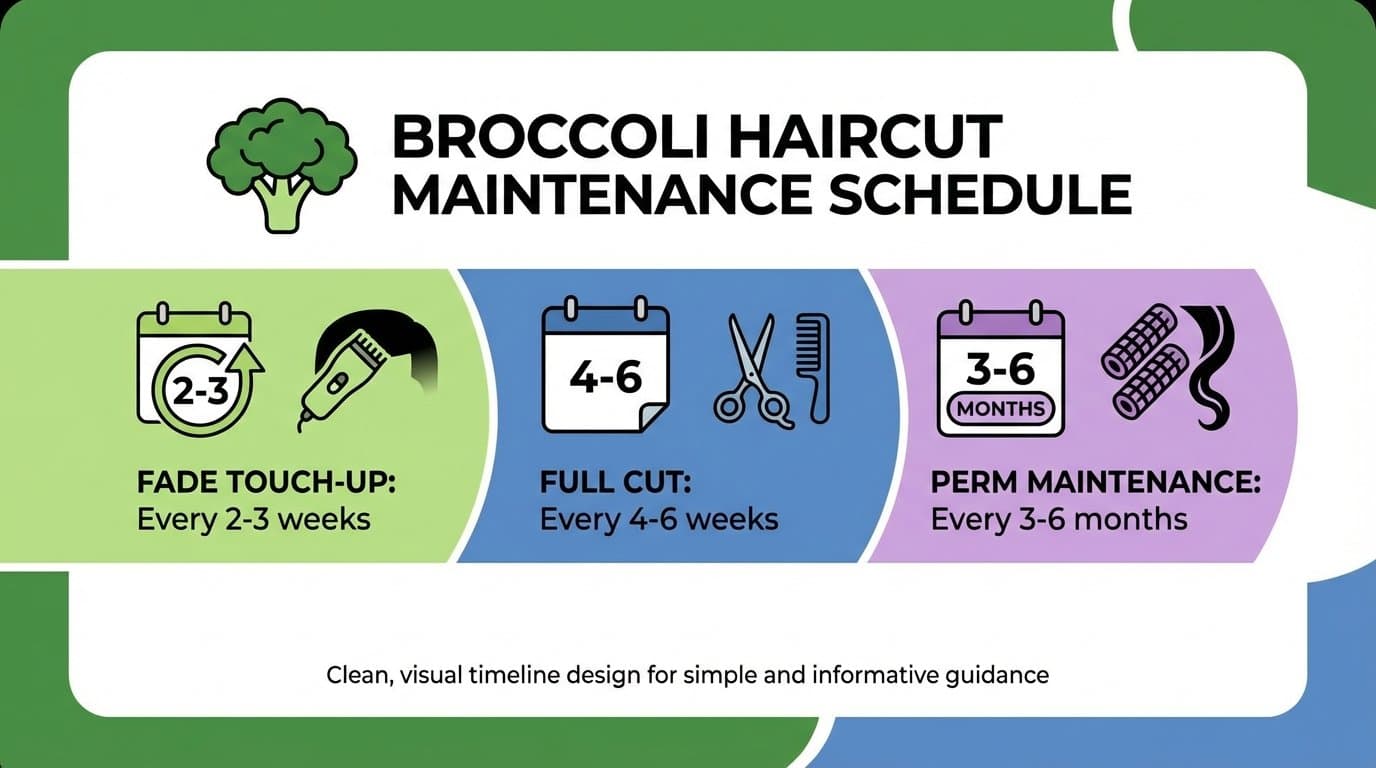
The broccoli cut's signature look comes from the contrast between curly top and short sides. That contrast disappears as the sides grow out. Different fade heights grow out at different rates — our fade and taper guide explains which ones stretch longest between cleanups.
Fade Maintenance: Every 2-3 Weeks
The faded sides grow out quickly. Within 2-3 weeks, you'll notice:
- Less contrast with the top
- Fuzzy, undefined edges
- That "growing out" look
If you want to keep the broccoli cut looking fresh, fade touch-ups every 2-3 weeks are necessary.
What to ask for: "Just clean up the fade, don't touch the top." For more on barber communication, see our complete barber guide.
Cost: Many barbershops charge less for a fade cleanup than a full cut. Ask about pricing for maintenance visits.
Full Cut: Every 4-6 Weeks
The curly top needs attention less frequently. Every 4-6 weeks is typical for:
- Trimming dead ends
- Reshaping the silhouette
- Adjusting for any uneven growth
What to ask for: "Full cut—clean up the fade and shape the top."
Perm Maintenance: Every 3-6 Months (If Applicable)
If you have a perm, your roots grow in straight. After a few months, you'll have:
- Curly permed sections
- Straight new growth at the roots
- An awkward transition zone
Options:
- Root perm: Perm only the new growth to match existing curls
- Full perm: Redo the whole thing (risky for overlapping with previously permed sections)
- Grow it out: Let the perm grow out and cut it off gradually
Most people opt for root perms every 4-6 months. Consult with your stylist about timing.
Monthly Maintenance: The Big Picture
Beyond daily styling and regular cuts, monthly check-ins help you stay on track.
Product Inventory
Take stock of your products:
- What's running low?
- What's expired or past its prime?
- What's not working anymore?
Restock essentials before they run out. Having backup products prevents scrambling.
Hair Health Assessment
Look honestly at your hair:
- Are there more split ends than usual?
- Does it feel dry or damaged?
- Is the curl pattern holding?
If you're seeing damage, consider:
- Cutting off damaged ends
- Reducing heat styling
- Adding protein treatments
- Scaling back any chemical processes
Adjust for Seasons
Hair behaves differently in different conditions:
- Summer: Humidity can cause frizz. Use anti-humidity products.
- Winter: Dry air causes static and dryness. Use more moisture.
- Swimming season: Chlorine and salt water damage perms and curls. Wear a cap or rinse immediately after swimming.
Adjust your routine as conditions change.
Product Recommendations by Category
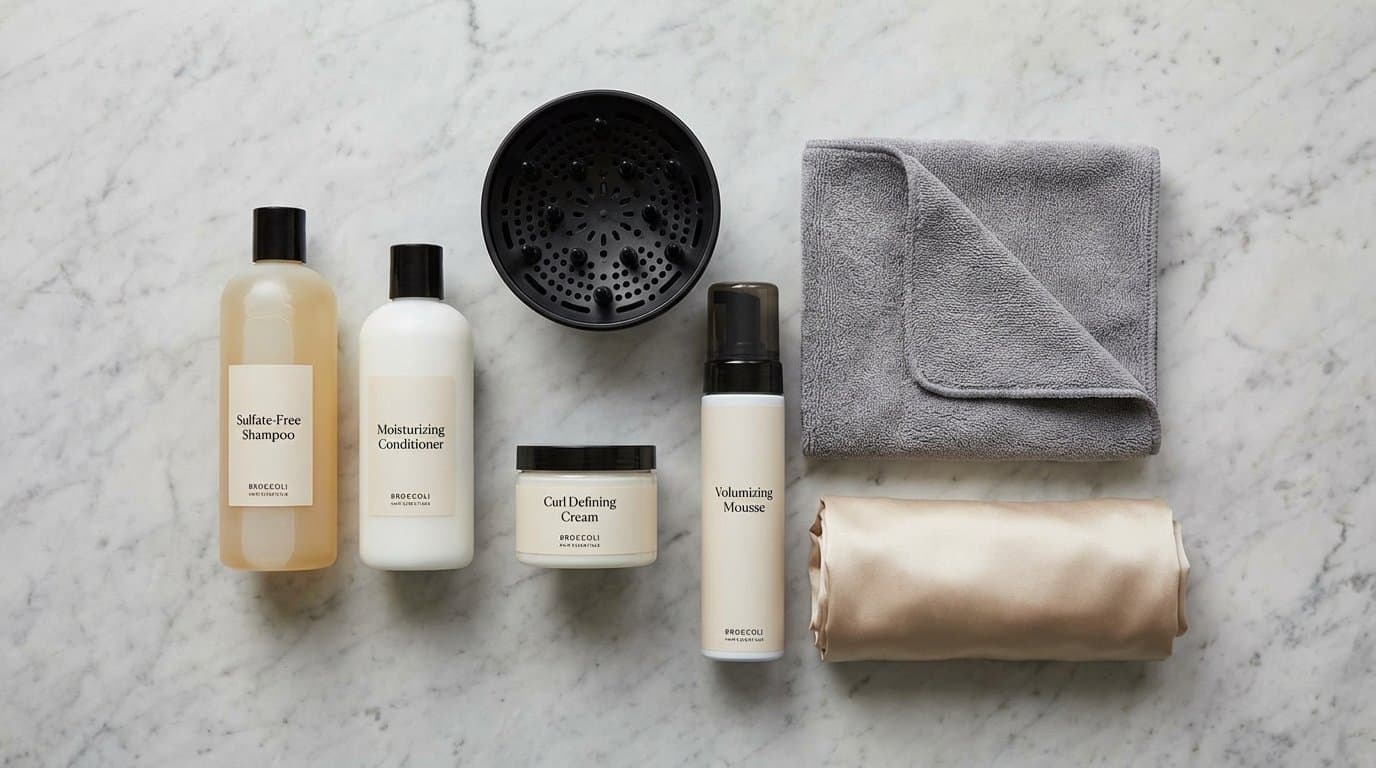
Shampoo
What to look for: Sulfate-free formulas. Sulfates strip moisture from curly and permed hair.
Types:
- Moisturizing shampoo: For dry hair
- Clarifying shampoo: For removing buildup (use sparingly)
- Low-poo: Very gentle, minimal cleansing
How often: 2-3 times per week maximum. Over-washing dries out curls.
Conditioner
What to look for: Rich, moisturizing formulas. Silicone-free if you prefer (though silicones aren't necessarily bad).
Types:
- Daily conditioner: Light, use every wash
- Deep conditioner: Intensive, use weekly
- Leave-in conditioner: Doesn't rinse out, adds ongoing moisture
Styling Products
Curl cream: Defines curls with a natural finish. Good for everyday. Mousse: Adds volume. Light hold. Great for fine hair. Gel: Strong hold and definition. Can be crunchy until scrunched out. Oil/serum: Adds shine and controls frizz. Use sparingly.
Tip: Many people layer products—leave-in conditioner first, then curl cream or gel.
Tools
Microfiber towel or t-shirt: Gentler than regular towels. Reduces frizz. Diffuser attachment: Essential for adding volume while drying. Wide-tooth comb: For detangling when wet (never brush curly hair). Silk/satin pillowcase: Reduces friction while sleeping. Preserves curls overnight.
Budget Breakdown: The True Cost
Let's be honest about ongoing costs.
Monthly product costs:
- Shampoo/conditioner: $15-30/month (depending on brand)
- Styling products: $10-25/month
- Deep conditioner: $10-15/month
- Tools (one-time): $20-50
Barbershop costs:
- Fade cleanups (2x/month): $30-60
- Full cuts (every 4-6 weeks): $30-50
- Perm maintenance (if applicable, every 4-6 months): $80-150
Total monthly estimate:
- Without perm: $75-150/month
- With perm: $90-180/month (averaging perm costs across months)
This isn't pocket change. But compared to other appearance-related expenses, it's in line with what many people spend on skincare, gym memberships, or other grooming.
Common Maintenance Mistakes
Over-Washing
Washing daily strips natural oils and dries out curls. Stick to 2-3 times per week.
If your scalp feels oily: Rinse with water between washes, or use a dry shampoo at the roots.
Using the Wrong Products
Products for straight hair don't work for curly hair. Make sure you're using formulas designed for your hair type.
Signs of wrong products:
- Curls falling flat
- Hair feeling weighed down
- Excessive frizz
- Product buildup
Skipping Heat Protectant
If you diffuse regularly, use a heat protectant. Heat damage accumulates over time and affects curl pattern.
Neglecting the Fade
A grown-out fade looks sloppy. Even if you're stretching time between full cuts, get the fade touched up.
Sleeping Wrong
Sleeping on cotton pillowcases creates friction. Curls can get smashed and tangled overnight.
Solutions:
- Silk or satin pillowcase
- Satin bonnet or hair wrap
- "Pineapple" technique (loose, high ponytail)
Frequently Asked Questions
Making It Sustainable
The broccoli haircut requires more maintenance than a buzz cut. That's the tradeoff for the look.
To keep it sustainable:
- Build routines: Make your daily styling and weekly treatments automatic habits.
- Schedule appointments: Put recurring barbershop visits in your calendar.
- Stock up: Keep backup products so you're never scrambling.
- Be realistic: If you can't commit to the maintenance, consider a lower-maintenance style.
Some guys realize after getting the broccoli cut that the maintenance isn't for them. That's valid. Better to know than to let the style deteriorate.
But if you're willing to put in the work, the broccoli cut rewards the effort. Fresh fades, defined curls, that clean contrast between top and sides—it looks good when you maintain it right. For the full picture of the men's style, from the cut to the perm to the upkeep, see our broccoli haircut for men hub.
The style isn't complicated. It just requires consistency.
Now you know what's involved. Time to build the routine.